Exoplanet atmospheres · Arizona State University

Luis Welbanks

I study the atmospheres of planets that orbit other stars. My group measures what they are made of with JWST, Hubble and ground-based telescopes, and we build the statistical tests that show how far each measurement can be trusted.

Assistant Professor, School of Earth and Space Exploration

Artist's concept: NASA and STScI

Portrait of Luis Welbanks
Photo: Drew Bird

About

I lead the Exoteric Lab at Arizona State University

I am an Assistant Professor in ASU's School of Earth and Space Exploration. Before joining the faculty in 2025 I was a NASA Sagan Fellow and then a 51 Pegasi b Fellow at ASU, after a PhD at the University of Cambridge as a Gates Cambridge Scholar.

My group works on both sides of a JWST spectrum. We measure composition, temperature, clouds and internal heat, and we test whether the models behind each claim are good enough to support it.

Observing programs

I lead and take part in observing programs on JWST, Hubble and the Gemini telescopes. STScI keeps the current list of JWST programs and their investigators.

Search “Welbanks” at STScI

Publications

My first-author papers include results in Nature and Nature Astronomy, and the publications page lists every paper, newest first.

All publications

Public talks

I founded Astronomy on Tap: Valley of the Sun in the Phoenix area, and I give talks and interviews about exoplanets in English and Spanish.

Press and outreach

Selected results

What the spectra show

All research themes
Transmission spectrum of WASP-107 b from 1 to 12 microns, with labelled features of water, methane, carbon monoxide, carbon dioxide, sulfur dioxide and ammonia.
Transmission spectrum of WASP-107 b from Hubble WFC3, JWST NIRCam and JWST MIRI. Credit: illustration by NASA, ESA, CSA and Ralf Crawford (STScI), science by the JWST MANATEE Team and Luis Welbanks (ASU).
Nature · 2024

A hot interior inflates the warm Neptune WASP-107 b

Hubble, JWST NIRCam and JWST MIRI spectra together show water, methane, carbon monoxide, carbon dioxide, sulfur dioxide and ammonia. Methane is far scarcer than expected at about 750 K, which requires an interior hotter than 345 K, and tidal heating from the planet's slightly elliptical orbit can supply that heat. The result made the cover of Nature on 27 June 2024.

Absorption cross-sections from 5 to 12 microns for dimethyl sulfide, dimethyl disulfide and several hydrocarbons, whose features overlap across the range.
Absorption cross-sections of dimethyl sulfide, dimethyl disulfide and several hydrocarbons across the JWST MIRI range. Welbanks et al. 2025, Nature Astronomy.
Nature Astronomy · 2025

Whether a gas is detected depends on the models compared

Reported detections of dimethyl sulfide and related gases on the sub-Neptune K2-18 b, proposed as possible signs of life, disappear once more molecules are allowed into the models. Many hydrocarbons absorb at the same MIRI wavelengths. We tested 90 of them one at a time, and for one reduction of the data, model comparison favored 59 at 2σ or more, six of them more strongly than dimethyl disulfide.

Artist's concept of the giant planet WASP-39 b beside its star.
Artist's concept of the giant planet WASP-39 b and its star, by NASA, ESA, CSA and Joseph Olmsted (STScI).
Nature · 2023

Carbon dioxide in the atmosphere of WASP-39 b

I coordinated the modelling for the JWST Transiting Exoplanet Community Early Release Science Program, in which more than 50 researchers interpreted JWST spectra of the giant planet WASP-39 b. The program identified carbon dioxide in an exoplanet atmosphere, and its first five papers appeared together in the 23 February 2023 issue of Nature.

Transit and eclipse spectra of WASP-80 b from 2.4 to 4 microns, with water and methane absorption shaded.
Transit (top) and eclipse (bottom) spectra of WASP-80 b from JWST NIRCam, with water and methane absorption shaded. Data from Bell, Welbanks et al. 2023, Nature.
Nature · 2023

Methane in the warm Jupiter WASP-80 b

Spectra taken with JWST NIRCam as WASP-80 b passed in front of and behind its star show methane and water vapor. Methane fills the atmospheres of Jupiter, Saturn, Uranus and Neptune, yet it had stayed hidden in transiting exoplanets observed from space before JWST.

PNAS · 2025

Searching for signs of life in the JWST era

With Sara Seager, Lucas Ellerbroek, William Bains and Janusz Petkowski, I reviewed what JWST's first results mean for the search for gases produced by life. Only a handful of temperate planets, all orbiting small, cool stars, are within JWST's reach.

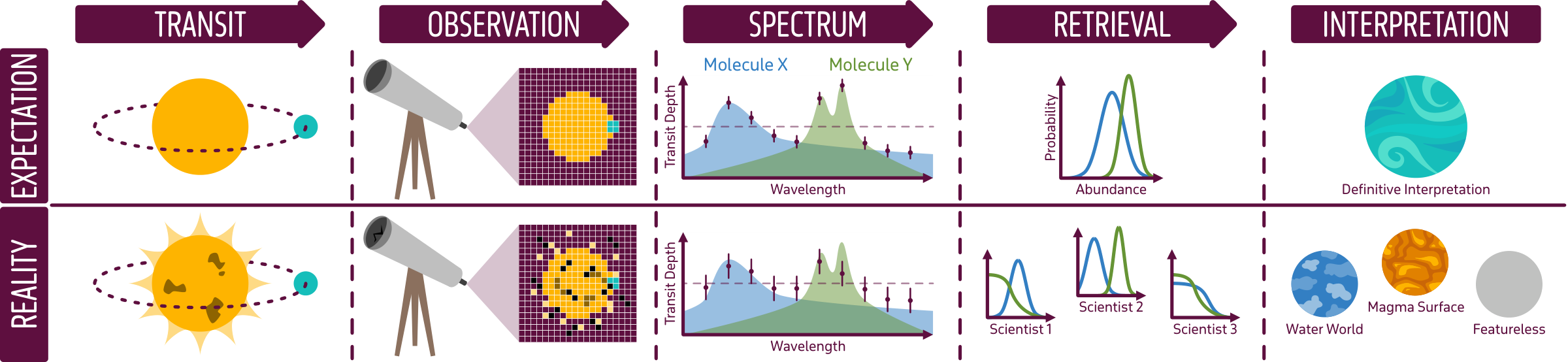
Getting from a transit to a claim about a planet takes four steps: the observations, the processing that turns pixels into a spectrum, the model fits that infer gas abundances, and the interpretation. For WASP-107 b, independent analyses agreed on its methane and on the chemistry that methane implies. For the sub-Neptune TOI-270 d, two teams found methane and water in the same JWST data. Small differences in the abundances then led one team to a water-rich planet with a hot ocean and the other to a thick atmosphere of hydrogen, water and methane over a rocky interior.

The claimed dimethyl sulfide on K2-18 b fails all three tests we set for any sign of life: a robust detection, attribution to the right gas, and an interpretation that excludes non-biological sources. JWST may be able to flag a planet as a candidate, but a reliable detection of life will need future telescopes.
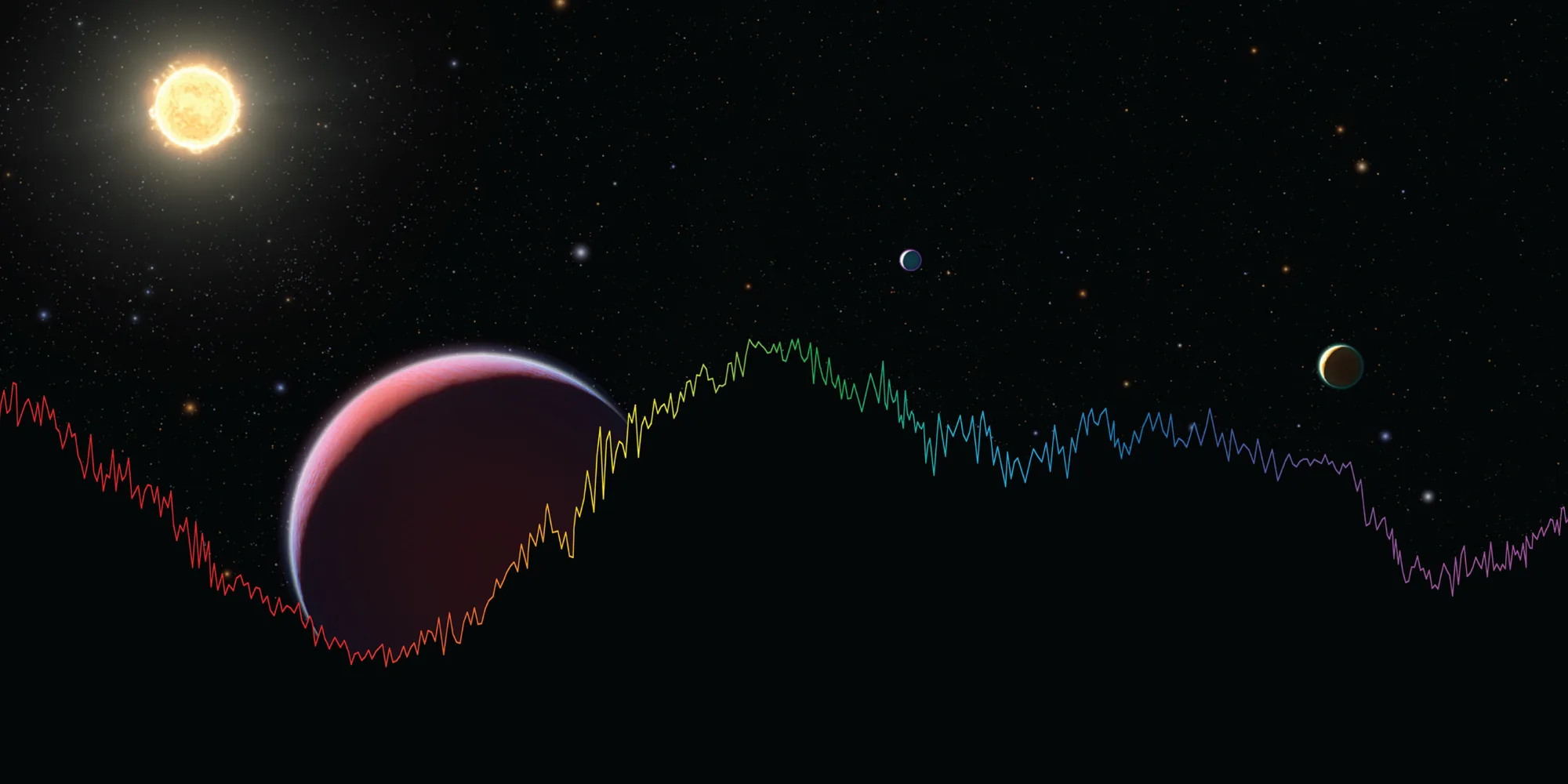
Diagram of the steps from a transit to an interpretation, in two rows. In the expected case, a quiet star, a clean detector image, a precise spectrum and narrow abundance estimates lead to one definitive interpretation. In practice, starspots and flares, detector defects, larger error bars and different results from three scientists leave a water world, a magma surface or a featureless planet as possible answers.
From a transit to an interpretation, as expected (top row, inspired by WASP-107 b) and in practice (bottom row, motivated by TOI-270 d). Starspots and flares, instrument noise and different analysis choices can leave several kinds of planet consistent with the same data. Seager, Welbanks et al. 2025, PNAS, Fig. 4. Credit: Seager, Welbanks, Tilke.

News

Recent news

Press and outreach
  • I talked with Mia Belle Parkinson on The Tartan Tardigrade, the UK Centre for Astrobiology's podcast, about the claims of biosignatures on K2-18 b and what the search for life should weigh in future claims (listen on Spotify).

  • PhD student Yoav Rotman led a study of what NASA's Pandora SmallSat, launched in January 2026, will measure in exoplanet transmission spectra (AJ, 2026, ASU News).

  • Sagnick Mukherjee found that clouds can heat the deep atmosphere of temperate sub-Neptunes such as TOI-270 d by 1,000 K or more, which changes the boundary between atmosphere and mantle (ApJ Letters, 2026, ASU News).

  • We make the case for a survey of sub-Neptune atmospheres with the proposed Nautilus Space Observatory (preprint).

  • A study in Science with Sagnick Mukherjee found clouds that form each morning and clear by evening on the gas giant WASP-94A b (ASU News).

  • Matthew Nixon's work on what sub-Neptunes are made of featured in ASU News: "New study revises our picture of the most common types of planets in the galaxy".

  • I was one of the two lecturers at Exoplanets by the Lake III, a summer school on JWST spectroscopy of exoplanet atmospheres at Lake Ammer, Germany, with four lectures on atmospheric models and retrievals.

  • The New York Times covered our Nature Astronomy paper on K2-18 b in "New Studies Dismiss Signs of Life on Distant Planet".

Publications

Recent papers

All publications
Luis Welbanks seated beside an illuminated transparent celestial globe.

Outreach

Talks for the public, in English and Spanish

In 2025 I founded Astronomy on Tap: Valley of the Sun, which brings public science talks to the Phoenix area. I give lectures for astronomy clubs, speak about exoplanets in Spanish, and am a subject matter expert for NASA's Universe of Learning.

My latest interview is on The Tartan Tardigrade, the UK Centre for Astrobiology's podcast, recorded at the CHEWIE workshop in Leiden.

Join the group

PhD students, postdocs and ASU undergraduates

PhD students join the Exoteric Lab through the graduate program of ASU's School of Earth and Space Exploration. I also support applications for independent postdoctoral fellowships, and I work with ASU undergraduates on research projects.