Research
Reading the atmospheres of other worlds
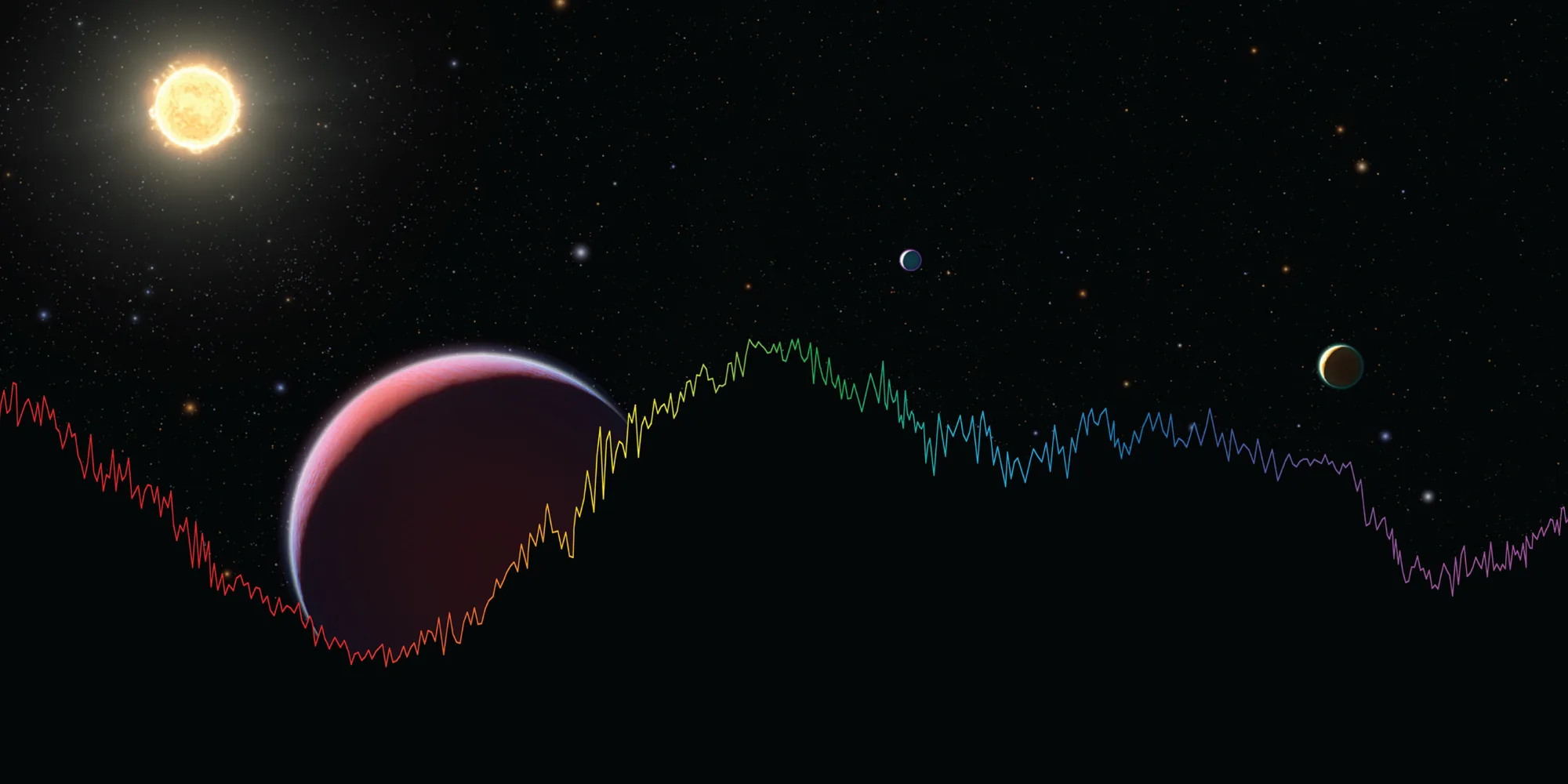
With JWST, the study of exoplanet atmospheres has gone from being limited by data to being limited by models. JWST now records a single planet's atmosphere from 0.5 to 12 microns, and the conclusion drawn from such a spectrum can depend on what the model was allowed to include.
My group works on both sides of this problem. We analyse spectra from JWST, Hubble and ground-based telescopes to measure composition, temperature, clouds and internal heat, and we develop statistical tests that show which parts of a spectrum drive each conclusion.
01 · JWST spectra
Reading atmospheres with JWST
I coordinated the modelling for the JWST Transiting Exoplanet Community Early Release Science Program, in which more than 50 researchers interpreted the first JWST spectra of the giant planet WASP-39 b. That program identified carbon dioxide in an exoplanet atmosphere, and its combined spectrum now spans 0.5 to 12 microns. Since then I have led or helped lead the interpretation of JWST spectra of giant planets such as WASP-80 b and HD 189733 b and of the sub-Neptune GJ 3470 b.
In the warm Neptune WASP-107 b, Hubble, NIRCam and MIRI data together showed water, methane, carbon monoxide, carbon dioxide, sulfur dioxide and ammonia. Methane is far scarcer than expected at about 750 K, which requires an interior hotter than 345 K, and tidal heating from the planet's slightly elliptical orbit can supply that heat and explain why the planet is so inflated.
Key papers
- A high internal heat flux and large core in a warm Neptune exoplanet, Welbanks et al. 2024, Nature
- Identification of carbon dioxide in an exoplanet atmosphere, JWST Transiting Exoplanet Community ERS Team 2023, Nature
- Methane throughout the atmosphere of the warm exoplanet WASP-80b, Bell, Welbanks et al. 2023, Nature
- Hydrogen sulfide and metal-enriched atmosphere for a Jupiter-mass exoplanet, Fu, Welbanks et al. 2024, Nature


02 · Statistics
Testing whether a detection is real
A molecule is usually reported as detected when a model that includes it fits the spectrum better than the same model without it, and that comparison depends on which other models were tried. In 2023 I introduced Bayesian leave-one-out cross-validation to exoplanet spectroscopy. It scores a model by how well it predicts each data point when that point is left out of the fit, which shows which wavelengths carry a claimed detection.
For the sub-Neptune K2-18 b, the reported detections of dimethyl sulfide and related gases, proposed as possible signs of life, disappear once the set of candidate molecules is widened. We tested 90 hydrocarbons one at a time, and for one reduction of the data, model comparison favored 59 of them at 2σ or more, six of them more strongly than dimethyl disulfide. We recommend treating model comparisons as tests of relative adequacy, supported by theory and other statistical checks, rather than as detections in themselves. My PhD student Yoav Rotman extends this work with Gaussian processes that absorb features the models miss.
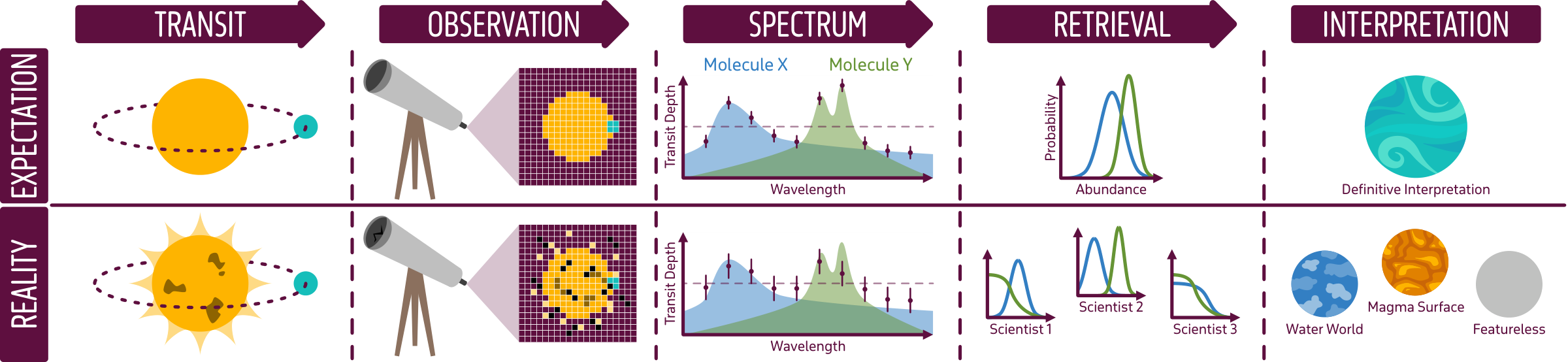
In a review led by Sara Seager, we proposed three tests for any claimed sign of life: a robust detection, attribution to the right gas, and an interpretation that excludes non-biological sources. The figure below shows where each step of an analysis can open up more than one answer.
Key papers
- Challenges in the detection of gases in exoplanet atmospheres, Welbanks et al. 2025, Nature Astronomy
- On the application of Bayesian leave-one-out cross-validation to exoplanet atmospheric analysis, Welbanks et al. 2023, AJ
- Enabling robust exoplanet atmospheric retrievals with Gaussian processes, Rotman, Welbanks et al. 2025, ApJ
- Prospects for detecting signs of life on exoplanets in the JWST era, Seager, Welbanks et al. 2025, PNAS
Work that uses leave-one-out cross-validation, in an ADS library


03 · Methods
Retrieval methods
A retrieval fits a flexible atmosphere model to a spectrum and returns every composition and temperature structure consistent with the data. During my PhD I wrote Aurora, a retrieval code for hydrogen-rich and hydrogen-poor atmospheres that handles patchy clouds and hazes and several sampling algorithms.
I have also studied where retrievals go wrong. One paper maps the degeneracies between parameters in transmission spectra of hot Jupiters, and another tests the biases attributed to one-dimensional models of planets whose morning and evening sides differ, which we traced to specific model assumptions. Matthew Nixon led a comparison of ways to combine the results of several models instead of choosing one.
Key papers
- Aurora: a generalized retrieval framework for exoplanetary transmission spectra, Welbanks & Madhusudhan 2021, ApJ
- On degeneracies in retrievals of exoplanetary transmission spectra, Welbanks & Madhusudhan 2019, AJ
- On atmospheric retrievals of exoplanets with inhomogeneous terminators, Welbanks & Madhusudhan 2022, ApJ
- Methods for incorporating model uncertainty into exoplanet atmospheric analysis, Nixon, Welbanks et al. 2024, ApJ
- Computational challenges in exoplanet atmospheric retrieval, Barstow & Welbanks 2026, Living Reviews in Computational Astrophysics


04 · Interiors
Interiors and sub-Neptunes
The composition of an atmosphere depends on what lies beneath it. In WASP-107 b the chemistry required both a hot interior and a core larger than earlier estimates. Sub-Neptunes, planets between Earth and Neptune in size, are the most common planets found so far and have no counterpart in the Solar System. My group models how a magma ocean reacts with the gas above it and how clouds change the temperature at the boundary between atmosphere and mantle, and we test these models against JWST spectra of planets such as TOI-270 d.
Key papers
- Magma ocean interactions can explain JWST observations of the sub-Neptune TOI-270 d, Nixon, Welbanks et al. 2025, ApJ
- Impact of clouds on the atmosphere–mantle interface of sub-Neptunes, Mukherjee, Welbanks et al. 2026, ApJL
- Sulfur dioxide and other molecular species in the atmosphere of the sub-Neptune GJ 3470 b, Beatty, Welbanks et al. 2024, ApJL

05 · Populations
Planets as a population
Many planets observed in the same way can test ideas about formation that a single planet cannot. Using homogeneous retrievals of 19 planets, from mini-Neptunes to hot Jupiters, we found that water abundances rise toward lower planet masses but stay below the trend that carbon follows in the Solar System's giant planets. A later study that added host-star abundances showed the sample was still too small to tell such a trend from no trend, and estimated how many planets a decisive test needs.
JWST spectra now allow statistical studies across many planets, and we contribute to them. For the proposed Nautilus Space Observatory, we make the case for a survey of sub-Neptune atmospheres large enough to map the population.
Key papers
- Mass–metallicity trends in transiting exoplanets from atmospheric abundances of H2O, Na, and K, Welbanks et al. 2019, ApJL
- A revisit of the mass–metallicity trends in transiting exoplanets, Sun, Wang, Welbanks et al. 2024, AJ
- Statistical trends in JWST transiting exoplanet atmospheres, Fu et al. 2025, ApJ
- Unveiling the diversity and origin of sub-Neptunes with the Nautilus Space Observatory, Welbanks et al. 2026, preprint

planets in our 2019 study of water, sodium and potassium abundances
planets with JWST-quality water abundances needed for a decisive mass–metallicity test (Sun et al. 2024)
06 · Ground-based
High-resolution spectroscopy from the ground
Spectrographs on large ground-based telescopes resolve thousands of individual molecular lines. As the planet orbits, its lines shift in wavelength while those of the star and of Earth's atmosphere stay put, and cross-correlating the spectrum with a model picks out the planet's signal. I lead observing programs with the IGRINS spectrographs on the Gemini telescopes, and with the Roasting Marshmallows program and other teams we measure abundances and temperatures in hot Jupiters.
Key papers
- The Roasting Marshmallows Program with IGRINS on Gemini South I: composition and climate of the ultrahot Jupiter WASP-18 b, Brogi et al. 2023, AJ
- The Roasting Marshmallows Program with IGRINS on Gemini South II: WASP-121 b has superstellar C/O and refractory-to-volatile ratios, Smith et al. 2024, AJ
- A measurement of the water abundance in the atmosphere of the hot Jupiter WASP-43b with high-resolution cross-correlation spectroscopy, Bartelt et al. 2025, AJ
- Revealing H2O dissociation in WASP-76 b through combined high- and low-resolution transmission spectroscopy, Gandhi et al. 2024, MNRAS
07 · Community and teaching
Missions, community projects and teaching
NASA's Pandora SmallSat, launched in January 2026, watches host stars in visible light while it measures near-infrared transmission spectra, so that starspots can be separated from planetary signals. Yoav Rotman led the study of what Pandora will measure for planets from hot Jupiters to temperate sub-Neptunes.
I also organise EXOMINTS, the EXOplanet Model Interrogation and New Techniques Sprint, which brings graduate students, postdocs and faculty together to work on methods for characterizing exoplanets. The 2023 meeting at ASU, funded by the Heising-Simons Foundation and the Other Worlds Laboratory at UC Santa Cruz, has already produced published papers.
In 2025 I taught these methods as one of the two lecturers at Exoplanets by the Lake III, a summer school on JWST spectroscopy of exoplanet atmospheres at Lake Ammer in Germany. My four lectures went from modeling atmospheres to K2-18 b as a case study, with hands-on notebooks on least-squares fitting, Bayesian model comparison and nested sampling. That year I also lectured at the Vatican Observatory Summer School on the first three years of JWST.
Key papers
- NASA's Pandora SmallSat mission: simulated modeling and retrieval of near-infrared exoplanet transmission spectra, Rotman, Welbanks et al. 2026, AJ
